The $500 HealthCare.gov Refund: Who Gets It, Is It Taxed?
The government is mailing a one-time $500 refund to some HealthCare.gov customers. Who gets it, how it arrives, the tax questions, and how to spot a scam.
Jump to section
TLDR
The U.S. Treasury is sending a one-time $500 refund to people who bought 2026 health insurance on HealthCare.gov and paid full price, with no help from the government. It is $500 per person on the plan. You do not need to apply. If someone calls, texts or emails you about it and asks for money or your bank details, it is a scam. The IRS has not yet said how the $500 is taxed, so keep the letter and a record of the payment.
Letters from the U.S. Treasury about a $500 refund started going out at the end of September. Here is what it is, in plain words.
#What is this money?
When you buy a plan on HealthCare.gov, the insurance company pays the government a small fee. This fee is called a user fee. It pays to run the website. The insurance company builds that fee into the price you pay each month. For 2026 plans, the fee was 2.5% of each monthly premium. (Your premium is the price you pay for your plan.)
The White House says these fees brought in more money than the website needed. It is now sending the extra money back as a one-time $500 refund. The White House calls it the “Working Families Obamacare Refunds.”
#Who gets the $500?
You get it if all three of these are true:
- You bought 2026 coverage on HealthCare.gov. This is the federal site. It is not the same as a state-run site.
- You paid full price. You did not get the premium tax credit. That is the government help that lowers your monthly bill.
- You live in one of the 30 states that use HealthCare.gov.
Those 30 states are Alabama, Alaska, Arizona, Arkansas, Delaware, Florida, Hawaii, Indiana, Iowa, Kansas, Louisiana, Michigan, Mississippi, Missouri, Montana, Nebraska, New Hampshire, North Carolina, North Dakota, Ohio, Oklahoma, Oregon, South Carolina, South Dakota, Tennessee, Texas, Utah, West Virginia, Wisconsin and Wyoming.
The refund is $500 per person. So a family with three people on a full-price plan could get $1,500.
Most people who qualify earn too much to get help with their premium. Many are business owners, self-employed people and early retirees who buy their own insurance.
#Who does not get it
- People who got any premium tax credit for 2026
- People who buy on a state-run site, like the ones in California or New York
- People who get health insurance from a job
#How and when does it arrive?
The government picked who gets it. There is nothing to sign up for.
Payments started going out on September 30, 2026. The White House says checks go out starting in October. Most reports say it comes as a paper check. Some say it may come by direct deposit. Each payment comes with a letter from the President.
The letter and the money may not come together. We have seen a letter show up with no check inside. If that happens to you, do not panic. Give it some time.
#What does the real letter look like?
Here is a real letter. We blacked out the name and address.
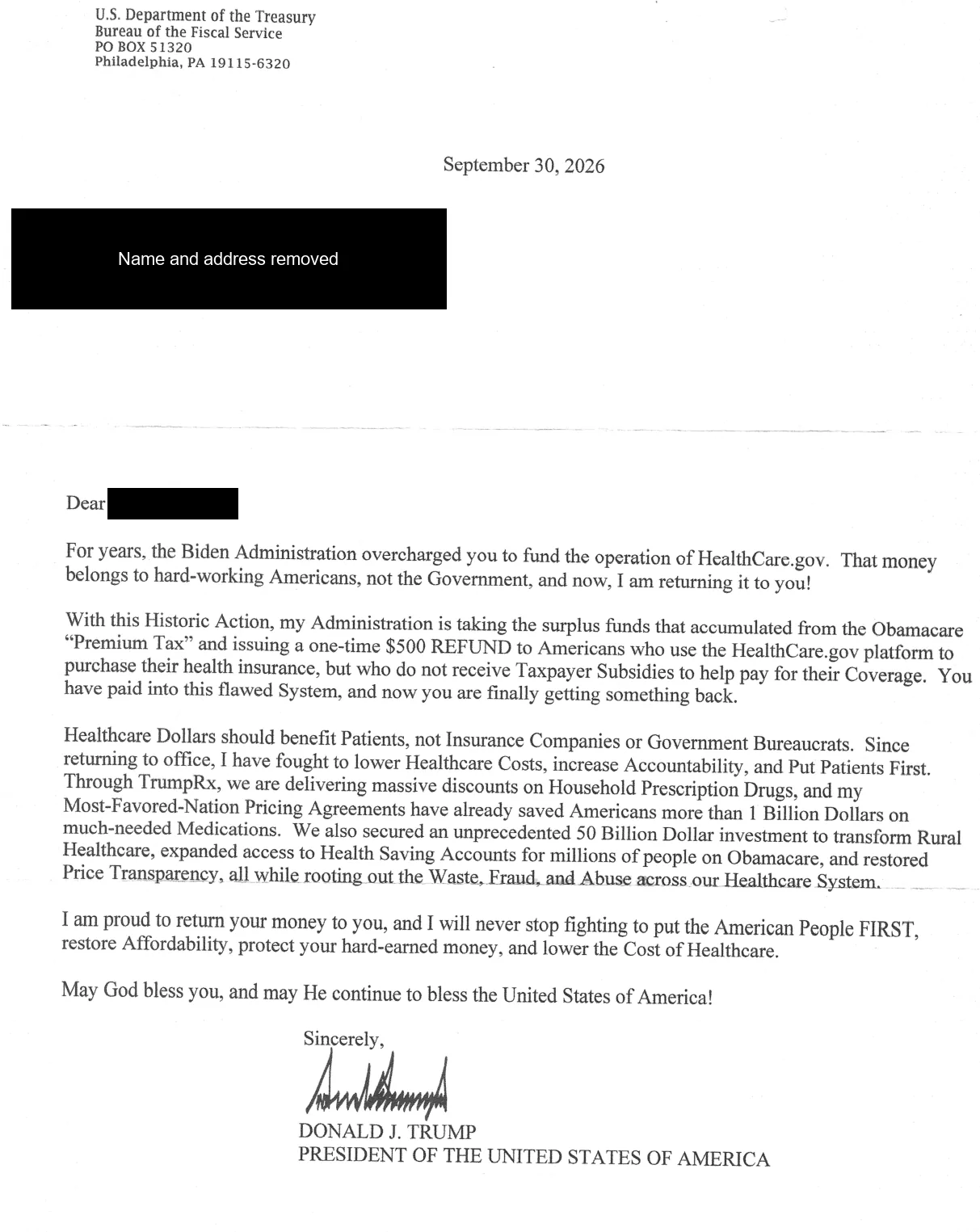
A real refund letter from the U.S. Treasury, dated September 30, 2026. The name and address are blacked out.
Here is how to know it is real:
- It comes from the Bureau of the Fiscal Service, PO Box 51320, Philadelphia, PA. That is part of the U.S. Treasury.
- It is one page, dated September 30, 2026.
- It is signed by the President.
- It does not ask you to call, click, pay or send anything.
#Is the $500 taxed?
The IRS has not said yet. We will update this page when it does. Here is what we know today.
The IRS has an old rule for a similar kind of money. When a health insurer pays back part of your premium (this is called a rebate), the IRS says:
- If you did not take a tax break for your premiums, the rebate is not income. It just lowers what you paid.
- If you did take a tax break for your premiums, the rebate may be income. It counts up to the amount of tax you saved.
You may have taken a tax break for your premiums if:
- You are self-employed and took the self-employed health insurance deduction, or
- You itemized and deducted medical costs.
This $500 is not a rebate from your insurer. It comes from the Treasury. So we do not know yet if the IRS will use that same rule. Until it says, here is what we suggest:
- Keep the letter.
- Write down the date and amount of the check or deposit.
- Tell us about it when you send us your 2026 tax papers.
If you take the self-employed health insurance deduction, this matters most for you. It could change the number we put on your return.
#How to spot a scam
Scammers love news about free money. Here is what the real payment will not do:
- It will not ask you to apply, sign up or call anyone.
- It will not ask for your bank account number by phone, text or email.
- It will not ask you to pay a fee to get your money.
- It will not ask you to pay with a gift card, crypto or a payment app.
- It will not send you a link to “claim” your refund.
The Federal Trade Commission says the government will not call, text, email or message you on social media to ask for money or personal information. Scammers can also fake the name or number that shows up on your phone.
If you get one of these calls or texts, hang up or delete it. You can report it at ReportFraud.ftc.gov. If you think someone stole your personal information, go to IdentityTheft.gov. You can also protect your tax return with an IRS Identity Protection PIN.
#A few open questions
This is a new program, and some things are still not clear:
- The White House has not named the law it is using to make these payments. Some policy experts have asked about this.
- The government has not said when all the payments will be done.
- The IRS has not said how to report the $500 on a tax return.
None of this changes what you should do today. If a real payment comes, you can cash it. Just keep good records.
#What to do now
- Watch your mail for a letter from the Bureau of the Fiscal Service in Philadelphia.
- Check your HealthCare.gov account to make sure your address is right.
- Ignore anyone who calls, texts or emails you about this refund.
- Save the letter and note the date and amount you got.
- Tell your tax preparer about it when you file your 2026 return.
If you buy your own health insurance and want to know how this fits into your taxes, we are happy to help. Bring the letter and your plan details, and we will walk through it with you.